Our Process
From Emissions to Economic Value: The 5-Stage Ecosonomic Closed Loop
Phase 01 — Enterprise Diagnostic & Bio-Engineering
Identifying carbon opportunities and designing commercially viable circular solutions.
Carbon Source Assessment: Assessing point-source CO₂ emissions, operational processes and relevant industrial byproducts to identify opportunities for biological carbon conversion.
Customized Engineering: Designing closed-loop microalgae cultivation and carbon conversion systems supported by real-time monitoring and MRV-ready data infrastructure.
Business Model Redesign: Identifying opportunities to transform sustainability expenditure into productive assets, low-carbon products and new commercial revenue streams.
Phase 02 — Biological Carbon Conversion & Productization
Transforming CO₂ into productive biological resources through microalgae.
Biological Bio-Fixation: CO₂ is introduced into engineered microalgae cultivation systems, where photosynthesis converts carbon dioxide into biological carbon contained within biomass.
Biomass Cultivation & Harvesting: Producing and harvesting microalgae biomass under controlled operating conditions for subsequent processing and utilization.
Commercial Product Development: Converting suitable biomass into value-added applications such as Bio-Enhancers, agricultural inputs, animal nutrition ingredients, bio-based materials and other sustainable products.
Phase 03 — MRV, Independent Verification & Environmental Value
Turning measurable environmental performance into credible and verifiable data.
Digital MRV: Capturing relevant operational data including CO₂ input, gas flow, conversion performance, biomass production and other parameters required to quantify environmental outcomes.
Independent Verification: Establishing data and documentation pathways that can support assessment by qualified third-party verification or certification bodies where applicable.
Verified Environmental Value: Translating measurable carbon and sustainability performance into credible environmental claims and, where an applicable methodology, standard and registry requirements are satisfied, potentially recognized carbon assets.
Phase 04 — Digital Carbon Infrastructure & Consumer Utility
Connecting verified environmental value with enterprises, products and consumers.
Digital Environmental Records: Using digital infrastructure and distributed ledger technologies where appropriate to create transparent and traceable records of verified environmental value.
Carbon Dots & Micro-Value: Translating eligible environmental value into smaller digital units that can support consumer participation, sustainability rewards and product-linked environmental programs.
Consumer-Brand Engagement: Connecting products and purchasing activities with measurable sustainability information, enabling consumers to understand and participate in environmental impact initiatives.
Phase 05 — Green Commerce & Ecosystem Value
Bringing environmental and commercial value together within a sustainable marketplace.
ESG Marketplace: Connecting microalgae-derived products, sustainable agricultural solutions and other qualified low-carbon products with B2B procurement and B2C consumer channels.
Environmental Value Utilization: Enabling verified environmental value and Carbon Dots to support appropriate enterprise sustainability programs, product initiatives, consumer rewards and other ecosystem applications.
Self-Sustaining Ecosystem: Revenue generated through technology deployment, products, services and ecosystem activities can support continued innovation, operations and expansion—creating a reinforcing cycle of environmental and economic value.
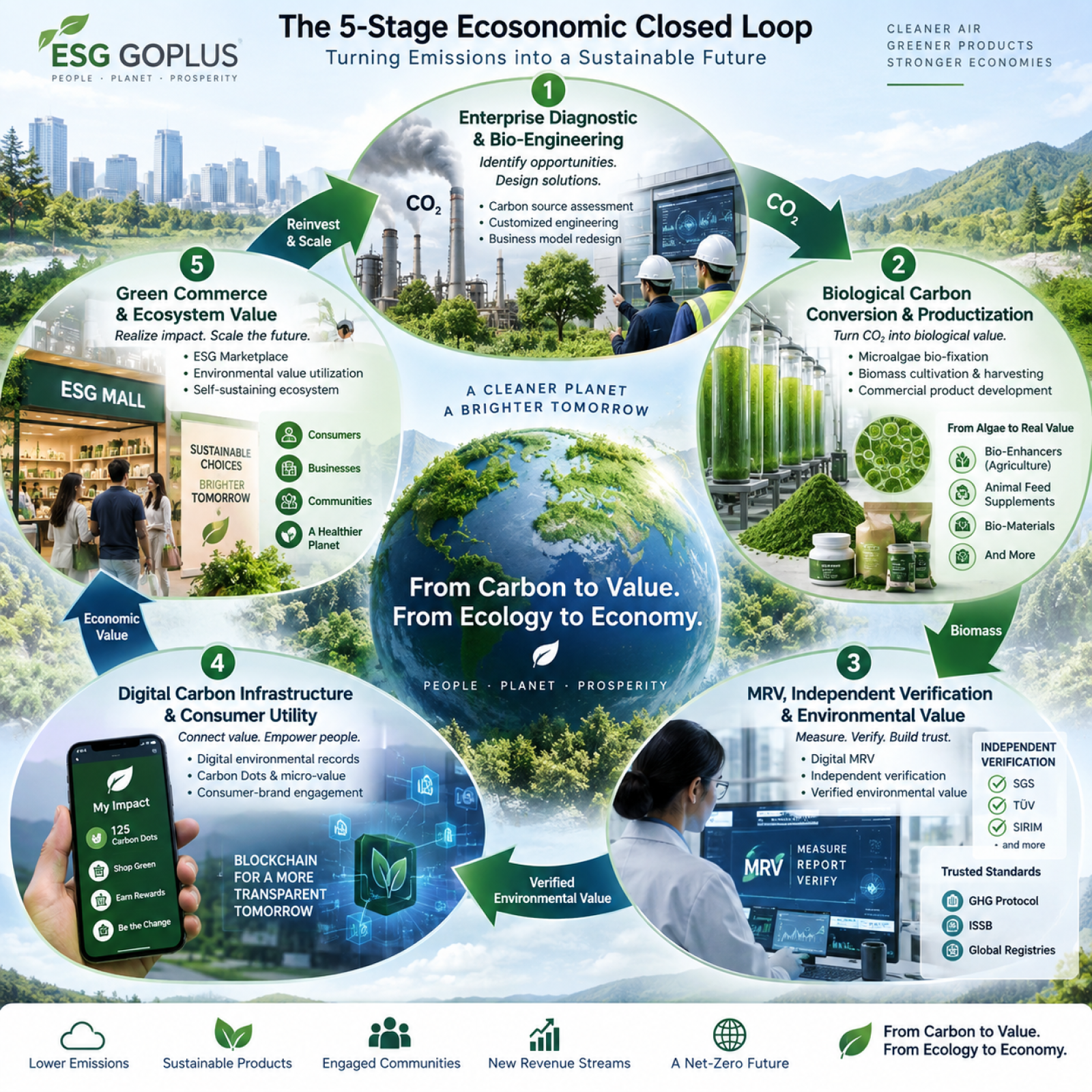
The Closed Loop
CO₂ → Biological Conversion → Biomass → Green Products → MRV → Verified Environmental Value → Digital Utility → Green Commerce → Economic Value → Ecosystem Expansion